
Argo CD says Synced. Did your migration actually run?
A green GitOps dashboard can confirm that resources converged without proving that a database migration ran. A reported Argo CD race makes that gap concrete; the practical response is to verify the release outcome, not just the sync.
In this story

Where the release can go wrong
A sync window, two operation paths, and an outcome worth verifying.
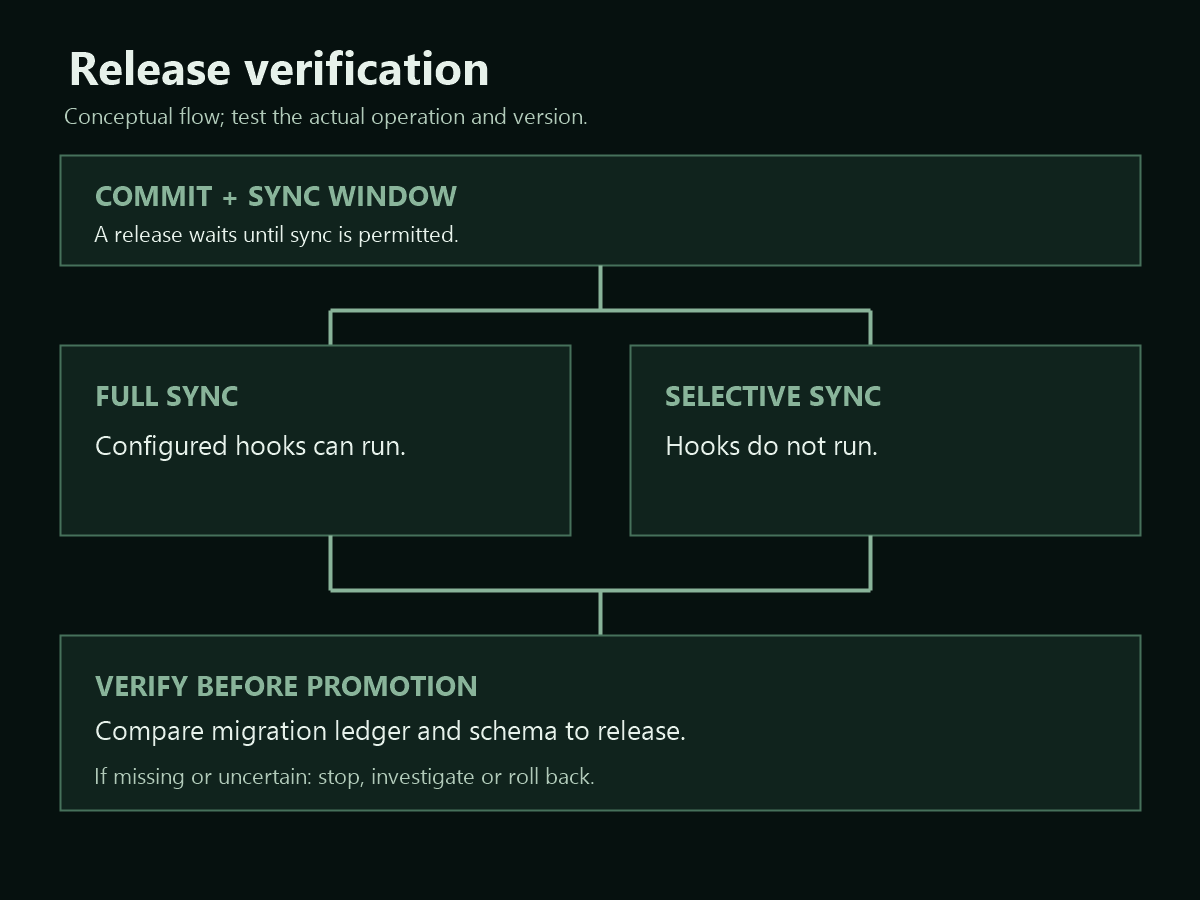
- The release waits
A commit arrives while a deny sync window is active.
- The window ends
The next operation matters. These paths do not provide the same hook behavior.
- Full sync
Configured hooks can run as part of the sync.
- Selective sync
Hooks do not run; selected resources can still change.
- Full sync
- Verify the outcome
Use an independent check of the migration ledger and schema before shifting traffic. If the workload is already live, follow your incident and recovery plan.
The release looked healthy. The schema was not.
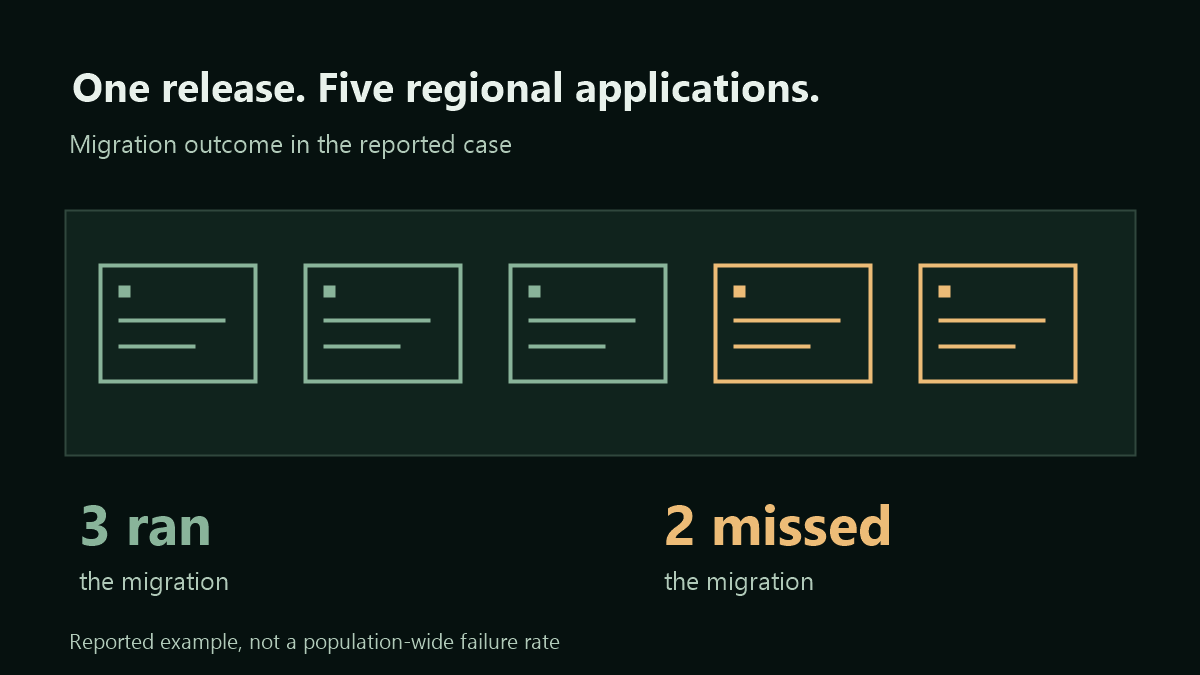
On 20 November, CNCF ambassador Afzal Ansari described a customer's release across five regional Argo CD Applications. According to the account, two Applications reached the new revision without running their migration hook; their new code then spoke to an incompatible schema for 36 to 44 minutes. The Applications appeared Synced and Healthy. The author also reports reproducing the behavior in a lab five times in six attempts. [1]
The reported setup combined automated sync, self-heal, a deny sync window and a migration implemented as a Sync hook. The author's explanation is that, after the window closes, a self-heal operation can win a race against a normal full sync and apply only selected out-of-sync resources. Argo CD's documentation separately states that hooks do not run during a selective sync. The exact race and its frequency are the author's account, not independently verified incident facts. [1] [2]
The broader issue: confirmation must follow action
The case matters if a release relies on a database change, data backfill or other side effect that is not itself verified before traffic reaches new code. A sync status describes a controller operation; it is not an end-to-end assertion that application, schema and customer-facing behavior agree.
In a separate 20 November InfoQ article about multi-region failover, Saurabh Ahuja argues for confirming the outcome after automated action, rather than stopping at an alert or a routing change. That is a useful operational parallel, not independent corroboration of the Argo CD incident. [3]
Investigate before changing production
Start with the exact Argo CD version, Application configuration and release history. Preserve controller logs, the Application operation details, the target commit, migration Job history and the database schema version before cleanup removes useful evidence. Do not infer this race from a green status alone.
In a disposable staging environment with a representative controller version and manifests, reproduce a release during a deny window. Compare the next full sync with self-heal and selective sync paths. Use a harmless test migration, observe the Job and target schema, and repeat: timing-dependent results are not a guarantee of production behavior.
Five checks for the next release
Agree on the expected schema version and verification method with the application and database owners. Run these checks in a safe environment first; adapt them to your release and rollback procedures.
- Inventory Applications with automated self-heal, sync windows and required migration or lifecycle hooks. Record Argo CD versions and identify every path that can apply workload changes.Evidence: An owner-reviewed inventory linking each Application, sync policy, window, hook and release dependency.
- Rehearse the window-close scenario using a disposable database and representative manifests. Inspect operation details and controller logs as well as the actual migration Job and schema version; include a normal full sync for comparison.Evidence: Timestamped staging runs connecting the commit, operation type, Job outcome and observed schema version.
- Add a release-specific verification gate that checks the actual schema or migration ledger before traffic is shifted. Define a timeout, alert and stop or rollback decision in advance; avoid putting destructive checks in a health probe.Evidence: A recorded pass or fail against the expected schema, with the release identifier and the resulting promotion decision.
- Evaluate a uniquely named, ordinary migration Job in an earlier sync wave, with idempotent migrations and a deliberate retention and pruning policy. Test successful, failing, retried and partial syncs on your installed Argo CD version; do not assume wave ordering alone protects resources omitted from a selective sync.Evidence: Staging records showing which resources each operation included, whether the Job completed before the workload changed, and how failures stopped or exposed the release.
- If considering temporarily disabling self-heal, document the drift-correction tradeoff, alert on drift and assign an owner to restore or replace the control. Also test application/schema compatibility and rollback, including irreversible migrations.Evidence: An approved temporary control, drift alert, expiry or follow-up owner, and a tested compatibility and recovery plan.
What this does not prove
The CNCF post is a first-person report and lab analysis; it does not identify a universal affected-version range, and we have not independently reproduced its race. Its author reports that switching to an ordinary Job in an earlier wave worked in one lab, but explicitly had not tested a deliberately failing migration. Do not treat that change, a PreSync hook or disabling self-heal as a universal fix. [1]
Check the documentation for your deployed version and test your own sync paths. A release-specific Job can be rerun if cleanup removes it and self-heal recreates it; idempotency, database concurrency controls and retention matter. Disabling self-heal also leaves drift uncorrected until another appropriate sync. The dashboard can be green and still need a second opinion.
Sources and limits
- CNCF: When a sync window closes: How Argo CD self-heal skipped the migration hook 20 November 2026. First-person incident and lab report; the race has not been independently reproduced here.
- Argo CD documentation: Sync Phases and Waves Primary documentation for hooks, selective sync and wave ordering; check the version that matches your installation.
- InfoQ: Building Reliability into the Cloud: Observability as the Control Plane for Multi-Region Failover 20 November 2026. Independent discussion of outcome confirmation in a different operational context, not verification of the Argo CD report.
- Argo CD documentation: Sync Windows Primary documentation for allow and deny sync windows and manual overrides.